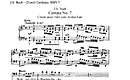
Cantata No. 7
- Composer
- Johann Sebastian Bach
- Opus
- BWV 7
- Instrumentos
- Voz, SATB, Orquesta
Partituras gratis
-
- Full score
- Instrumentos
- Voz, Orquesta
-
- Vocal score
- Instrumentos
- Voz, Teclado, Piano
Buy printed editions
We have selected some printed editions we think may be useful.
-
- Now Thank We All Our God (from Cantata No. 79)
- Precio
- $4.95
- Instrumentos
- Organ
- Editor
- Alfred Publishing
-
- Cantata No. 78: Jesu, der du meine Seele
- Precio
- $4.95
- Instrumentos
- Choral, Vocal
- Editor
- G. Schirmer
-
- Cantata No. 78 -- Jesu, der du meine Seele
- Precio
- $6.95
- Instrumentos
- Choral, Vocal
- Editor
- Alfred Publishing
Acreca de
Christ unser Herr zum Jordan kam (Christ our Lord came to the Jordan), BWV 7, is a cantata by Johann Sebastian Bach.
It was written in Leipzig for the Feast of John the Baptist, and was first performed on 24 June 1724. It is based on a chorale of the same name by Martin Luther.
The piece is written for two oboes d'amore, solo violins, ripieno strings (violins, violas and basso continuo), vocal soloists and choir. It is in seven movements, in E minor unless otherwise noted:
The above text is available under the Creative Commons Attribution-ShareAlike License ( creativecommons.org/licenses/by-sa/3.0/ ). It uses material from the Wikipedia article "Christ unser Herr zum Jordan kam, BWV 7" ( en.wikipedia.org/ ... _Herr_zum_Jordan_kam,_BWV_7 ).
It was written in Leipzig for the Feast of John the Baptist, and was first performed on 24 June 1724. It is based on a chorale of the same name by Martin Luther.
The piece is written for two oboes d'amore, solo violins, ripieno strings (violins, violas and basso continuo), vocal soloists and choir. It is in seven movements, in E minor unless otherwise noted:
- Chorus: "Christ unser Herr zum Jordan kam" - a gapped chorale setting of the tune. The soprano, alto, and bass voices sing free counterpoint, while the tenor voices sing the chorale unadorned in long notes.
- Aria: "Merkt und hört, ihr Menschenkinder" ("Mark and hear, you sons of mankind") - for basso and continuo (G major).
- Recitative: "Dies hat Gott klar mit Worten" ("This God has clearly with words") - for tenor and continuo (D minor).
- Aria: "Des Vaters Stimme ließ sich hören" ("The Father's voice can be heard") - for tenor, two solo violins and continuo (A minor).
- Recitative: "Als Jesus dort nach seinen Leiden" ("As Jesus there, after his Passion") - for bass, strings and continuo (B minor).
- Aria: "Menschen, glaubt doch dieser Gnade" ("People, believe this grace now") - for alto, oboes d'amore, strings and continuo.
- Chorale: "Das Aug allein das Wasser sieht" ("The eye sees only water") - the last verse of the chorale, sung and played by the whole ensemble.
- Amsterdam Baroque Orchestra & Choir, dir. Ton Koopman, Soloists: Sibylla Rubens, Annette Markert, Christoph Prégardien, Klaus Mertens - J.S. Bach: Complete Cantatas Vol. 11, Antoine Marchand
The above text is available under the Creative Commons Attribution-ShareAlike License ( creativecommons.org/licenses/by-sa/3.0/ ). It uses material from the Wikipedia article "Christ unser Herr zum Jordan kam, BWV 7" ( en.wikipedia.org/ ... _Herr_zum_Jordan_kam,_BWV_7 ).
Outros títulos
Christ unser Herr zum Jordan kam, Christ our Lord came to the Jordan